Art Waves commentaries, 2004-2009: A Selection
© 2010 Helen A. Harrison. No reproduction without permission.

Theft: A Love Story
Broadcast 8/31/06
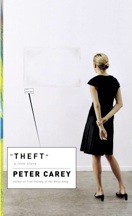 In Peter Carey’s new novel, everyone is a crook. The primary narrator, a washed-up Australian painter named Michael Boone, alias Butcher Bones, steals from his patron, who has stolen Michael’s wife. The ex-wife, Michael believes, has stolen his paintings, as well as their son, in the divorce settlement. Michael, in turn, steals someone else’s wife, Marlene Liebowitz, who steals anything that isn’t nailed down–and more. Even the detective who pursues her reveals himself as a petty thief. Dealers steal from artists, collectors steal from dealers, and so it goes, right down to the New York taxi drivers who rob Butcher of his equilibrium–or at least give him someone else to blame for his agitation and clouded judgment.
Michael’s mentally retarded brother Hugh–or Slow, as his nickname has it–steals more benignly, almost by default. His is the other narrative voice, a dark, distorted echo of his brother’s. He reminds me of John Steinbeck’s Lenny in “Of Mice and Men,” large, strong and volatile, a protector and an avenger. His real crime is to witness the fraud and deception all around him, which makes him potentially even more dangerous. In a sense, you might say that he steals the truth and stores it away in his poor, addled brain. Occasionally it comes spilling out, and that’s always messy.
This larcenous tale is set in the art world of the early 1980s, when Michael’s star is most definitely on the wane. Now in his late 30s, he’s already a has-been in the insular Australian art market, where he was cock of the walk–pun intended–ten years earlier. Oh, the fickle finger of fate. We might muse that this son of a provincial butcher had a phenomenal run of luck, first to escape the family business, which his rough-hewn father was grooming him to inherit–hence his nickname. Then actually to achieve some measure of success as an artist, even if only in his homeland. But no, Michael is mordantly bitter, self-flagellating and comically hapless, a cross between Kurt Vonnegut’s Rabo Karabekian and Joyce Carey’s Gully Jimson–which made me wonder whether Peter Carey is related to the author of “The Horse’s Mouth.”
The plot hinges on the theft of a very valuable painting by Marlene’s long-dead father-in-law–a cubist ranked right up there with Picasso and Braque–and the disappearance of another of his masterpieces. It has a couple of unlikely twists, which I won’t give away, although I will say that the ending is a bit too pat for my taste. The book’s real rewards are in the reading itself, in Carey’s use of language, although it’s very hard to find a suitable passage to quote on the air. The text is heavily larded with vulgarity and profanity, which gives it an earthy tone that suits the characters perfectly. It also cleverly masks the quicksilver turns of phrase and the dead-on aperçus that give Carey’s writing its punch.
Here is Hugh reflecting on his brother’s reaction to Marlene’s promise to get him a solo show in Tokyo:
“It is a big bloody mystery to me that a man so set against Queen Elizabeth of England could get himself so rigid about the crown princess of Japan, but soon he has a great stiffy, throbbing like a sock full of grasshoppers. And who am I to understand his secret squirming brain?”
No mystery at all, Slow Bones. You got the simile just right, and you nailed your brother’s hypocracy in that about-face on royalty. Principles be damned. This is his chance for a comeback. And he’s about to grab it by the you-know-whats.
In fact, this is not so much his comeback as his payback for the enormous favor he’s about to do Marlene, who has a vested interest in, shall we say, his success. In the end, the artist is nothing more than a hired gun, producing to order what he thinks, or knows, will please his client. That he happens to be in love with his client is a minor complication. In their odyssey from Sydney to SoHo, Michael discovers the true extent of Marlene’s thievery, but along the way he accumulates a raft of insights–none of which are of any use to him, of course.
Time, the greatest thief of all, teaches him nothing.
For “In the Morning,” I’m Helen Harrison.